
Why I think better in outlines than in prose
There's something about writing in outlines that helps me structure my thoughts better

Note 1: Writing in outlines simply means writing in nested lists with bullet points. Keep this in mind as you read this post.
Note 2: This post is based on my own experience with note-taking, and it definitely doesn’t apply to everyone. Don’t consider it an absolute source of truth, but something to think about.
I started using outliners when I was in university. My first outliner (and probably my favorite, before TreeWrite) was Dynalist. It was with Dynalist that I discovered what an outliner was and how to think and take notes in outlines.
For some reason, the first time I used an outliner, it was like a click in my mind: suddenly, writing notes was as simple and straightforward as thinking. I don’t directly attribute this to Dynalist (despite it being an excellent app), because during my classes I only had a clipboard, paper, and a pen to take notes, and even then I still used the outline structure.
The barrier of writing in prose
Section titled “The barrier of writing in prose”Before I started with this whole idea of writing in outlines, I used to take notes the same way I write an article or a blog post, that is, I wrote complete sentences in prose to express the idea I wanted to write down.
One thing I’ve noticed is that the problem with prose is that between thinking of a concept and writing it down, there’s a barrier of translation that needs to be done mentally.
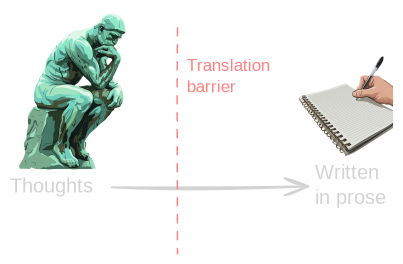
This barrier of translation exists because the way we think (or at least the way I think) is in terms of facts and connections between those facts. Translation involves transforming those facts and connections into well-formed sentences, which isn’t always easy or straightforward.
Note that all note-taking applications that are not outliners, including those that store notes in pure markdown, have this limitation I’m discussing. Applications like Obsidian, Joplin, and Notion.
Let me emphasize that I’m not saying that writing in prose is an impossible task (if that were the case, I wouldn’t be writing this post), but rather that there is a barrier that needs to be overcome to transform your thoughts into writing. Overcoming this barrier depends on how accustomed you are to writing in prose and your level of vocabulary and grammar.
Why is outline writing easier than prose?
Section titled “Why is outline writing easier than prose?”So prose has this barrier of translation that makes writing down our thoughts less direct. But doesn’t writing in outlines also have this limitation? Isn’t writing in outlines sometimes as hard as writing in prose, or even harder?
I don’t think so, and I’ll explain why with examples.
Represent prose as an outline, but not the other way around
Section titled “Represent prose as an outline, but not the other way around”Anything that can be written in prose can be represented in an outline.
This fact alone indicates that outlines are either equivalent to, or better than, prose, but never worse, since prose is a subset of the larger set of outlines.
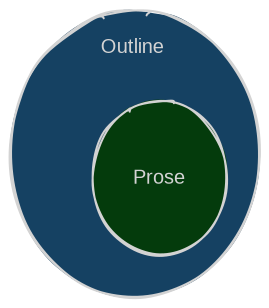
Consider the example below, which demonstrates a text written in prose and an equivalent in outline:
Prose
Millions of years ago, Earth was warm and covered in forests. In this environment, dinosaurs emerged and dominated the planet for a long time.
Some were giant herbivores; others, ferocious predators. About 66 million years ago, an asteroid struck Earth and brought an end to their era.
Outline
- Millions of years ago, Earth was warm and covered in forests. In this environment, dinosaurs emerged and dominated the planet for a long time.
- Some were giant herbivores; others, ferocious predators. About 66 million years ago, an asteroid struck Earth and brought an end to their era.
However, there are outline representations that cannot be written in prose, as in the example below:
Outline
- How old is a dinosaur fossil?
- The rocks around it hold radioactive isotopes, which decay at a known rate
- Solving the formula for t gives the age of the rocks, and so of the fossil
- age.js
const age = (n, n0, lambda) => Math.log(n0 / n) / lambda;
This outline cannot be represented in prose because prose is organized into paragraphs, and the outline is organized into nested lists.
You could say it would be possible to represent this with Markdown lists, but most Markdown implementations do not support code and formulas in lists.
In fact, some outliner apps can’t even represent that kind of outline, since some of them don’t support code or math formulas out of the box. TreeWrite aims to be complete in that respect, offering several types of bullets.
Nesting represents proximity
Section titled “Nesting represents proximity”One major advantage of outlines that I don’t see talked about much is that nesting bullets indicates a proximity between them.
As I mentioned, I think in terms of facts and connections. Prose isn’t always easy to write because I need to translate those facts and connections into paragraphs using grammar and vocabulary.
However, with outlines, each fact can be written in a bullet, and similar facts are connected through nesting. See the example below:
Prose
Octopuses have three hearts: two of them pump blood through the gills, while the third pumps it to the rest of the body, and since this third heart stops beating when they swim, they prefer to crawl.
Outline
- Octopuses have three hearts
- Two pump blood through the gills
- One pumps it to the rest of the body
- It stops beating when they swim, so they prefer to crawl
Note that in this example the prose became much less straightforward to write than the outline, because it required:
- Announce the breakdown with a colon (“three hearts: two of them…”)
- Contrast the siblings with “while the third…”. In an outline, they just sit side by side
- Say which heart is meant. In an outline, the “It” in the last bullet unambiguously refers to its parent, thanks to the nesting. In prose, you have to name it again: “this third heart”
- Chain everything into a single sentence, which ends up long and harder to read than the outline
To me, this shows why outlines are easier to write than prose, and why there’s no translation barrier between thoughts and outlines.